
-The best evidence for human marketers comes from the platforms selling the automation. A close read of the failures, fixes, and quiet reversals.
Here is the odd thing about marketing AI. The best evidence for human marketers comes from the platforms selling the automation.
Advertisers report Meta ads shipping with cropped logos and music nobody chose. Meanwhile, brands that swapped people for software keep walking the decision back. One Dutch McDonald’s campaign lasted three days.

This post makes a focused case. We will look at how marketers fold every tool into one workflow. Then we will test what language models can and cannot do, and what the public failures reveal.
Is Marketing Really Immune? Not Quite, and That Is the Point
Let’s be precise. No profession is immune to AI. Claiming otherwise is the same hype we criticise.
Still, marketing has a structural edge. Its output is judged by human behaviour: a click, a purchase, a shrug. Software can draft the message. It cannot feel the room where that message lands.
Consider what the work actually is. We guess how strangers will react, ship the guess, and read the evidence. Then we guess again. That loop rewards judgment under uncertainty, which is exactly what automation handles worst.
Meta’s ambitions show the tension. Reports say the company is targeting full AI automation of ad creation by the end of 2026. Under that plan, advertisers supply a URL and a budget while AI handles the rest. Yet the complaints keep piling up.
So here is our thesis. AI will take tasks. It will not take the profession, because the profession is the judgment wrapped around the tasks.
We Don’t Fight the Tools. We Conduct Them.
Every craft has a stack. Ours includes analytics, a CRM, ad managers, creative suites, and now language models. Good marketers plug each one in where it earns its keep.
That integration is the real advantage. A designer can use AI for mood boards. A media buyer can use it to spot anomalies. A strategist can use it to cluster customer reviews. Nobody in those roles stops thinking.
Here is how a typical workflow splits the labour.
| Stage | What AI does well | What the marketer decides |
|---|---|---|
| Research | Summarises reviews, clusters keywords | Which insight is genuinely new |
| Drafting | Produces 20 headline variants fast | Which three carry the brand voice |
| Testing | Rotates creative, shifts budget | Which test is worth running at all |
| Measurement | Crunches attribution data | Whether the number is trustworthy |
| Governance | Flags anomalies | Whether to override the platform |
Notice the pattern. AI widens the funnel of options. We narrow it. Speed goes up, and so does the quality bar, because we spend less time on grunt work and more on the decisions that matter.
Agencies that grasp this are already shifting. As one practitioner write-up puts it, the paid media job is moving from configuring campaigns to governing automation. Governing takes skill. It is not a smaller job.
What Language Models Actually Are
Strip away the branding and a language model predicts likely text. It learns patterns from enormous amounts of writing. Then it produces what usually comes next.
Researchers made this point early. The well-known Stochastic Parrots paper described such systems as stitching together linguistic forms by probability, without reference to meaning. The full text is openly available if you want to read the argument yourself.
To be fair, this view is debated. Newer models do more than simple mimicry, and reasonable people disagree on how much. However, the marketing implication holds either way. A model has no stake in your quarter, no memory of your customers’ complaints, and no consequences when the ad flops.
Details are where campaigns live or die. Consider the gap between “Free shipping” and “Arrives before the weekend.” One is generic. The other answers a specific anxiety.
Compliance shows the same gap. A guide on Advantage+ policy violations notes that testimonial text paired with guarantee imagery can imply guaranteed results. A pattern engine sees two harmless assets. A trained marketer sees a rejected ad, or worse, a regulator.
The Brands That Swapped People for Software
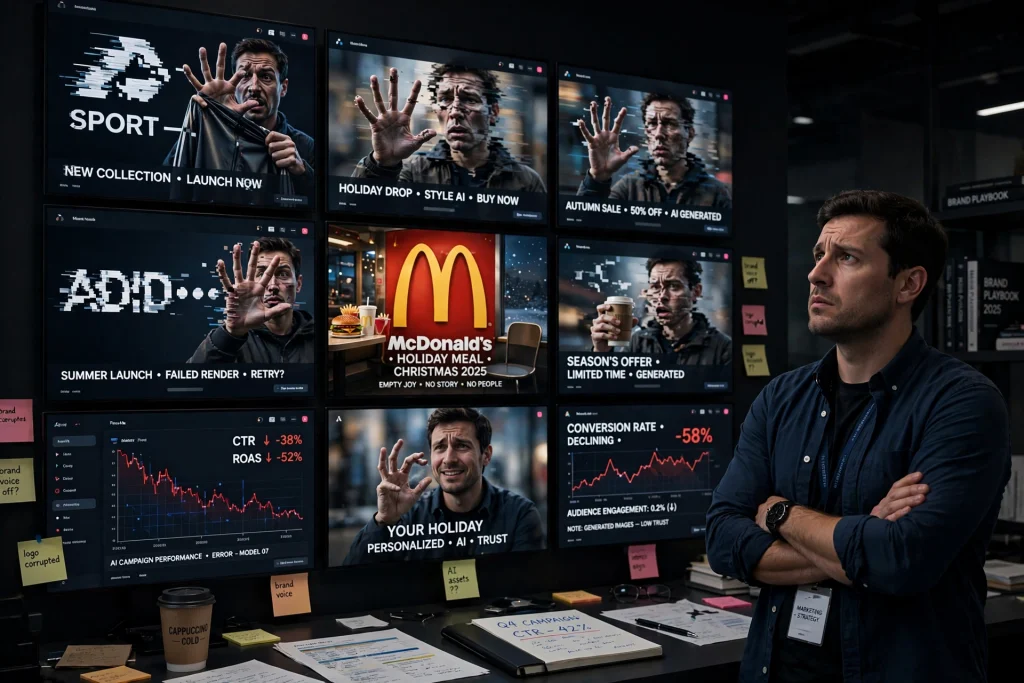
Replacing marketers with AI is not a theory. Several companies ran the experiment in public.
- Klarna: It froze hiring and moved marketing and support work to AI, claiming big savings. Its CEO later said customers should always be able to reach a human. The sharpest reversal came in customer service, where satisfaction reportedly fell.
- Duolingo: Its AI-first messaging triggered a backlash. The brand wiped its social feeds, then its CEO clarified that AI is a tool and no full-time staff were being replaced.
- McDonald’s Netherlands: A 45-second AI-generated Christmas spot went live on 6 December and came down on 9 December. The company called it an “important learning.”
The picture is not one-sided. Coca-Cola kept using AI after criticism, and a BBC-cited report found 61% positive sentiment for its latest spot. Even the McDonald’s production company stressed the enormous human effort behind the film.
That detail matters. The winners used AI as a material, not a replacement. Korn Ferry’s CMO has even noted that a third of managers say they rehired people AI was meant to replace.
Where Meta’s Automation Stumbled
Meta’s tools offer the clearest case study, because the complaints are documented and recurring.
In 2024, advertisers said Advantage+ Shopping campaigns inflated costs by as much as 10x and burned daily budgets within hours. Meta said technical issues were fixed. Advertisers kept complaining.
Support made it worse. Reports described sudden CPM spikes and little transparency, with help requests routed to chatbots after layoffs. A broken tool plus no human to call is a rough combination.
Creative automation brought a different flavour of trouble. Brands like True Classic saw elderly models replacing millennials and distorted body parts in generated ads. Meanwhile, Advantage+ Creative applies enhancements by default, including cropped logos and added music.
Context matters here. Meta merged its manual and Advantage+ Shopping flows in February 2026, so automation is now the default. Manual control is the exception you must choose on purpose.
Fairness check: Meta reports roughly 22% higher return for Advantage+, but that is Meta grading its own automation. Treat it as a claim to test, not a fact to bank.
Google’s Black Box Problem
Google tells a similar story. Performance Max is powerful, and many accounts do well with it. However, you can’t choose specific keywords or placements, because Google’s AI decides when and where ads show.
Transparency is the recurring sore spot. Google said it intentionally withholds channel-specific KPIs, arguing they can mislead. Sceptical advertisers wonder whether that serves them or the platform.
Brand safety added fuel. Independent research found large brands such as BMO and Intuit appearing on child-oriented YouTube channels through Performance Max. Google later added content suitability filters.
Here is the telling part. Google eventually added search term insights and more controls, plus a detailed FAQ answering advertiser concerns. Those upgrades came from human pushback. Marketers did not just use the system. They shaped it.
Industry commentary notes that some see these products as reducing buyer transparency even as they promise better results. Others point out that balanced setups give the best mix of control and scale.
Why Manual Work Still Wins the Best Results

Let’s avoid a lazy conclusion. These tools did not simply fail. They work well on average, and averages are the problem.
A platform optimises for its own incentives and for the typical advertiser. Your business is not typical. It has a margin structure, a seasonal rhythm, and a brand voice that no default setting knows.
Maximum results come from humans placing guardrails around the machine. In practice, that means:
- Audit defaults: Check which enhancements are silently on before launch.
- Protect the creative: Disable edits that touch logos, text, or music.
- Feed clean signals: Automation optimises toward whatever conversion data you give it.
- Cap waste: Limit spend on existing customers and set exclusions deliberately.
- Verify the numbers: Challenge platform-reported results with your own data.
Think of it as piloting a plane with autopilot. The autopilot handles cruising. The pilot handles takeoff, weather, and the moment something goes wrong.
Craft, Not Magic: Why Persuasion Stays Human
Some call marketing a divine art. We would call it a craft with a spark in it. Either way, the spark is human.
Persuasion lives in small choices. The rhythm of a headline. The word that signals “this is for people like you.” The typography that makes a price feel fair instead of cheap. These choices read the audience, and audiences differ by culture, mood, and moment.
The McDonald’s spot shows what happens when mood is misread. Critics called the tone cynical, and the visuals looked rushed and emotionally flat. The idea itself was not absurd. The reading of the room was off.
One more word on ethics. Great marketing influences by being relevant and honest, not by tricking people. We want customers to choose us with open eyes. That standard needs a person who can be held accountable.
Models average everything they have seen. Memorable work is specific, strange, and sometimes wrong in a productive way. Someone has to take that risk and own the result.
Your Move This Week
Stop asking whether AI will replace you. Start asking where your judgment is thinnest.
First, audit every automated setting in your ad accounts. Second, write down your brand’s voice rules so any tool, or any new hire, can follow them. Third, build a human review gate before anything AI-generated goes live.
Then raise your game. Learn the tools deeply enough to know when they are wrong. That skill compounds, and it is the one platforms cannot automate for you.
Legal Disclaimer
This article is for general information and opinion only. It is not legal, financial, or professional advice. Platform features, policies, and performance results change often and vary by account. Verify current details with official platform documentation and qualified advisors before making business decisions. Third-party sources are cited as published, and the author does not control their content.